
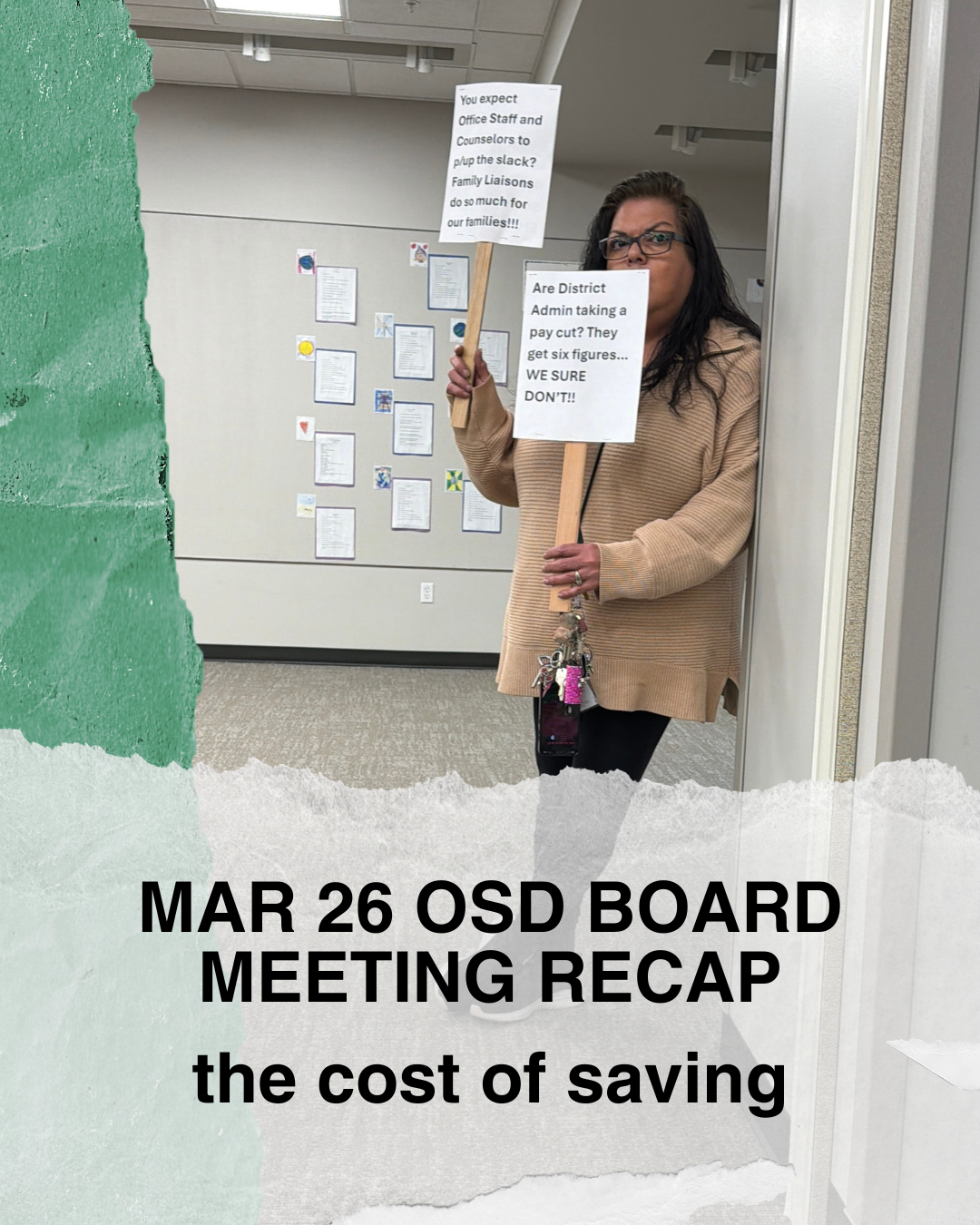

At the March 26th Olympia School District board meeting, Superintendent Patrick Murphy presented his Initial Reduction Plan, and the board tabled the planned second readings on several policies and procedures, including policy 1400 which pertains to which students and community populations are allowed to give public comment. This policy will receive its second reading now at a future board meeting. All board members, except Vice President Maria Flores, held off on commenting on Murphy’s reduction in force plans until the work session on Thursday, April 2.
The meeting began with public comments. There were originally 19 people signed up for public comment, including one student. One speaker was absent and two others were removed from the commenters list. Vice President Flores was facilitating the meeting and made the call to give all the presenters 3 full minutes instead of the 2 minutes that they had been told they would receive. “I’m gonna take a chair prerogative and extend it to 3 minutes apiece, but let me preface this with some information. We’re all gonna get our chance to speak. And we’re in the middle of discussing, as a board, our policy around public comment, so what I would like us to do is be as efficient as possible to show that we can be efficient with 3 minutes.”
Via zoom student speaker Jackson Rannow raised issues with the district’s current use of Chromebooks for students citing concerns on data harvesting. He suggested Apple’s Neo and other alternatives and urged the district to give power to the teachers to control which sites were accessible. There were some technical difficulties when Jackson started and Vice President Flores used grace to allow Jackson to speak and indeed everyone in the room was in suspense to hear what he had to say. Unfortunately, a $1.2m purchase of chromebooks was approved in the consent agenda.
Many commenters were there in support of the employees directly affected by the proposed reduction in force such as family liaisons, art teachers, as well as classroom teachers that will be cut due to increasing some class sizes. Parent Maria DeLacy spoke of Mohamed “Mo” Elsokkary, a family liaison at Garfield Elementary School. “There’s an immense amount of labor and love that goes into these positions, and the loss of his position seems, frankly, counterproductive. You might be saving however much money Mo makes in a year, or how those five support staff make, but the amount of money you’re losing because these students aren’t getting the support that they need, and an example of people from underserved communities who can show examples of success, it’s going to far outweigh any advantages that you get.”
There were also comments on Policy 1400. Brian Brannies also brought up the Collective Bargaining Agreements that are consistently pushed through the consent agenda without discussion or report to the public how that is affecting the budget.
We finally reached the regular agenda item 3.1 Initial Reduction Plan Proposal where Superintendent Murphy began a presentation on declining enrollment. In the enrollment projections presented he estimated kindergarten enrollments in FTE units (full-time equivalent) from district birth counts. Typically, enrollment projections use headcount, which is a direct count of students.
At this point, our very own Erika Lari called a Point of Order from the crowd as enrollment projections were NOT on the agenda. Vice President Flores told Lari she can’t call a point of order and after a couple of exchanges regarding protocol, Lari left the meeting.
Lari later stated, “Vice President Flores has since addressed my lack of parliamentary procedure knowledge and I was completely out of order. I apologize to anyone at the meeting or watching that was distracted by that. I called a point of order because the timing of presentations on the agenda was just discussed at the March 12 board meeting. Though going to a public facing website was not out of order, public commenters and anyone else attending the meeting had no idea we were going to have an enrollment report. Going forward, the board agreed to post references to links being presented that are not in the presentations, and that is incorporated in the April 2 work session.”
After his enrollment projection presentation Superintendent read the proposal that was included in the meeting packet, however there were some things that had already happened such as he mentioned reducing two executive directors of education to one, but this happened last year when James Whitehead was made Assistant Superintendent and Inger Owen was made Executive Director of Teaching & Learning. We fail to see how this is a savings. Taking two positions, creating a NEW position with a higher salary for one, and consolidating the others is a net gain in spending. There were other examples of this as well as when Superintendent Murphy cited savings because the money could come out of levy funds. We are still spending the money, so not saving.
Following this presentation, all board members, except Vice President Flores, opted to save their questions and comments for the work session, which seemed at the behest of the Superintendent from Director Seidel’s comments. Seidel said, “I also wrote mine down, in advance, and was planning to send those to the Superintendent, because that was part of the request over email, too, was to make sure that we clearly communicated that.” No action was taken.
Moving onto Agenda Item 3.2 Policies 1005, 1620 and Procedures 1005P and 1620P were approved, and policy changes to 1400 were tabled after a discussion regarding a proposed change that was later withdrawn to coalesce the comments into a more cohesive document.
The final public commenter of the evening Mike Taylor suggested that the public and board review what Binding Conditions mean. Taylor said, “I read through the Washington Association of School Administrators FAQ from October of 2024, and binding conditions really don’t seem that bad. I’d encourage everyone to Google WASA and binding conditions, and you’ll find the FAQ. Binding conditions don’t start until a negative ending fund balance is projected for a fiscal year. Then the school district agrees to be bound by certain conditions. But authority for making local decisions stays in the hands of the local school board and district leaders. The state does not take over schools in binding conditions. Finding conditions does not give the state power to fire or hire district staff, including the superintendent. And the state cannot cancel existing contracts or labor agreements.”
“It’s really not much. Honestly, if more districts were in binding conditions, maybe it would wake up state government and make them realize they’re failing our students. Frankly, I would encourage all districts to be in binding conditions. And I know this is just kicking the can down the road, something the district has done in the past, but honestly something we likely all do in our daily lives. Past Mike can be a real inconsiderate jerk sometimes. But maybe kicking that can down the road will buy us enough time.”