

The History of Our School Buildings
One of the first schools in the territory, this is the Olympia School District’s first school from 1852, located at 5th and Washington where you can now get treats at Lolli Llama Candy. We’ll begin revisiting our history over the coming weeks and what has happened to our buildings (all 19.5 of them), in light of the district’s plans to close 4 buildings & ask this community for a bond to build a new one.

Choose a school (we will add them as we go)

Avanti High School
When the current Avanti High School was built in 1924, there were around 9,000 residents in the Olympia School District, and 6 schools. McKinley School, Washington School, Lincoln School, Roosevelt School, Garfield School, and William Winlock Miller (Olympia) High School. The old Washington School, built in 1891, faced Quince St in the future Daley Arts Center Building’s current location. Famed Washington architect, Joseph Wohleb (Capitol Theater, Olympia Press Building, the future Daley Arts Center Building) was awarded the contract for a new building for $115,500, outside his architect fee. The coal tunnel below the building leads to the Madison bus barn!
The school operated as Washington School and Washington Junior High before outgrowing the space in the late 1960s. It then became the district office or ‘Old Washington.’ In 1987, it was renamed the Knox Administrative Center in honor of Esther Knox, the longest serving board member in the district (1952-1983), and voluntary district historian. Her guideline for schools is just as important today, “Is it good for the kids?”
In 1997, Olympia Alternative High School opened in the bottom two floors, and was renamed by inaugural principal Rich Matzen as Avanti, an Italian word meaning, ‘go forward & welcome.’ The Avanti remodel was in the 2016 bond. The administrative center moved into the Olympian Building. The third phase of the remodel remains incomplete.

Photos: About 1891, Olympia Tribune Souvenir Issue, Washington State Library
1930s, Merle Junk photograph, Susan Parish Collection, Washington State Archives

Boston Harbor Elementary School
Boston Harbor is the only school in our district whose entire service area remains outside Olympia city limits. As such, it began as its own district. In July 1964, the K-8 Boston Harbor District was consolidated with the Olympia School District. The school had already been built and moved several times since the area became a district in 1909.
The building that served as the school site from 1938-1990 cost $24,000. With adjoining land costing $9,000 in 1967, there were additions built, but in 1990, a long awaited bond was voted on for a new $2.3m Boston Harbor Elementary School, an 8 classroom school in pink, yellow, and blue. And then, there’s the castle.
In fall 2005, the Boston Harbor School PTA received a large anonymous donation with a challenge to build a new play structure for the school.
The remainder of the 2005-06 school year was spent planning, designing, fundraising, and organizing. A planner spent a day at the school involving all the students in developing the design – a castle motif along with a lighthouse, boat and other accents to add local flavor. Teams were organized to cover volunteer recruiting, fundraising, safety, tools, provisioning supplies, providing meals for volunteers, and logistics. Donations came in from numerous businesses and individuals; the North Olympia Fire Department provided incredible support.


Over 500 volunteers including parents, students, teachers and staff, and local community members spent a week building the play structure with guidance and direction from on-site Leathers staff. Local artists contributed custom decorations adding to the local connection. Working together, we built community as much as a play structure, establishing deep friendships that continue to this day. Ongoing energy from the project led to numerous investments for school improvement over the next several years. The school continues to be central to the fabric of the Boston Harbor community.


Photos: Original Boston Harbor School, approximately 1909, Boston Harbor pre-1990, current Boston Harbor building, private collection
2005-2006 Castle building photos, Milt Harper

Capital High School
Capital High School was a project planned as early as 1961, when the tract of land where it sat was purchased from the Yauger family for $16,000. In 1972, after finally passing a bond, the land was worth over $100,000 Bennett, Johnson, Slenes, and Smith designed the building which cost $5.7m and was slated to open for the 1975-76 school year. Taxpayers were reimbursed $1.4m at the end of the project when state legislators came through with more funding. It was a promise from the board. It would be Olympia’s 15th school.
Capital, chosen from multiple names, including Esther Knox High School. It was rejected by the consequence of long-serving board director Knox being alive. She managed change orders so well that the $195 cost of the restroom gender signs were refused because she could stencil it herself. She got her way and the district was not charged for the work.


The building was not ready at the start of the school year and students were housed for 3 months at the First Methodist and First Baptist churches. The school fed from Boston Harbor Elementary, John Rogers Elementary, Reeves Middle School, and parts of Roosevelt Elementary School, as well as all westside schools at the time (McLane, LP Brown, Garfield, & Jefferson).
The boundaries did not work out well. They were soon adjusted to split the east and westside, and the great Cougar vs. Bears/Westside Bestside rivalry began!
Olympia High School had over 1,800 students in a building built for 1,400 at the time. The westside grew quickly, but enrollment projections showed over 7,000 students on the westside alone by 1990. That didn’t happen, but the school grew faster than space allowed.
In 2005, a $10.5m renovation by McGranahan Partnership of Tacoma modernized the building and added a new common are and several learning pods. And in the 2016 bond, a $27m Performing Arts Center was added to the building.

Photos: 1975, Esther Knox, A Diary of the Olympia School District 1852-1976
Ballot pamphlet from 1972, Madison Elementary PTO Archives
Current Capital PAC image, copyright Michael MacSems

Centennial Elementary School
The history of Centennial Elementary School is inextricably linked to the school it replaced, McKinley Elementary School. McKinley was first built in 1909 to serve the southeast. It was located on the plot that ORLA currently sits on. There were less than 1,000 students in the district. The building was destroyed by fire in 1913 and a second building suffered earthquake damage in 1949. It was rebuilt for $1,100 in 1913, and again rebuilt for $469k in 1950. It was designed by Naramore, Bain, Brady, and Johanson.
As the Eastside grew, McKinley, Roosevelt, and Lincoln were not poised to hand the influx. Both Rogers & Madison Elementary Schools were added to the Eastside in 1956, but the aging McKinley structure was not being tended to at the pace it needed work. Asbestos work kept the building empty for years after it was closed. Multiple water leaks and a lack of space left students eating in the hallways.
But its closure was also blamed on its proximity to Madison Elementary School, which was then on 10th and Central St. Growth near Yelm Highway called for a different school location, and the school community was allowed to help name the school. Centennial was chosen because it was opening in time for Washington’s centennial celebration in 1989.
The school was paid for by a $21.9m bond in 1984, and has received multiple modernization upgrades in the years since.

Photos: Esther Knox, A Diary of the Olympia School District 1852-1976
Olympia School District

Garfield Elementary School
There wasn’t a bridge between east and west Olympia until 1869, but the earliest westside school opened in 1893 as, simply, Westside School. In 1902, it was renamed Garfield after the 20th president.
The original building aged heavily in 36 years, and, in 1929, Joseph Wohleb was again contracted to build a district school. The land cost $15k and the building was $130k. The superintendent during the time, Leland P. Brown, led the district through the Depression and World War II, and sold unused district property to pay for building upgrades.
Joseph and Robert Wohleb’s architecture has defined much of Olympia, but the school district had many of their most definitive buildings. While the Avanti and Lincoln Options buildings remain, Garfield Elementary was demolished in 1989. It was not a popular decision. The BJSS Architect & Planning took on the new Garfield for $2.8m. A further modernization from a 2012 bond cost over $20m, significantly emphasizing sustainability, was done by McGranahan Architects and FORMA. Though they are on their 4th school, they remain the center of their NW neighborhood.


Photos: Merle Junk, Garfield Elementary School between 1927 and 1933, Washington State Digital Archives, Susan Parish Photograph Collection, 1889-1990
Garfield School, 2012, photograph by Matt Kennelly
FORMA construction
Olympia School District

Madison Elementary School
Our schools have a complex history. Some have changed names and/or moved. Some have had multiple school models in them. It can be hard to say what the anniversary of a school is, but some are coming up. Avanti High School will turn 30, Jefferson Middle School will turn 70, and Olympia High School will be 120 next year, and this year, we celebrate the 70th anniversary for the Madison Lion Cubs.
In the early 1950’s, the boundaries and grade configurations of our bordering districts were different. East Olympia Elementary School, now part of a unified K-12 district, would feed into Olympia High School. The 6-3-3 grade model was adopted at the time (1-6/7-9/10-12… remember, no all day kinder!), and it required more schools to operate equitably. That’s how Madison Elementary School, Rogers Elementary School, and Jefferson Middle School came to be.
The original Madison Elementary School sat on a hillside below, what is now known as, Madison Scenic Park (named after the school) in southeast Olympia. The initial building cost the district $270k, and was designed by Wohleb & Wohleb, In 1996, when the proposal for a bond to rebuild Madison Elementary School was presented, Building Director, Bob Wolpert said, “The district could close Madison and place students in other schools, but that would destroy a long-term successful neighborhood school program.” Madison is one of the most geographically difficult areas to split without a feeder break, and Wolpert spoke to the difficulty and expense of a boundary review.
The district had 8,882 students and 19 schools that year. Though the $5.8m building was built on Legion Way, next to the Knox Administrative Center (now Avanti High School), the old building had not outgrown its useful life like the district claimed. In 2013, Madison classes entered the old building, as well as Roosevelt Elementary School and Rogers Elementary School, (closed in 2001, in part due to the state of the structure), when dry rot was found in the structure’s walls. In a 2013 Olympian article the then-new and now beloved Madison principal, Domenico Spatola-Knoll, said he framed it as a camping trip. “You don’t pack everything, and you can’t wait to go home.”


Old Madison is currently owned by the New Bridge Community Church, one of several patrons of the free supplies at Madison. To another 70 years…
Photos: 1956 Madison PTO Archives
Old Madison & Madison Scenic Park, Anita Wesselman collection, circa early-1990s
1998 Madison construction, Anita Wesselman collection
Madison with Rainbow, Domenico Spatola-Knoll
Old Madison today, New Bridge Community Church
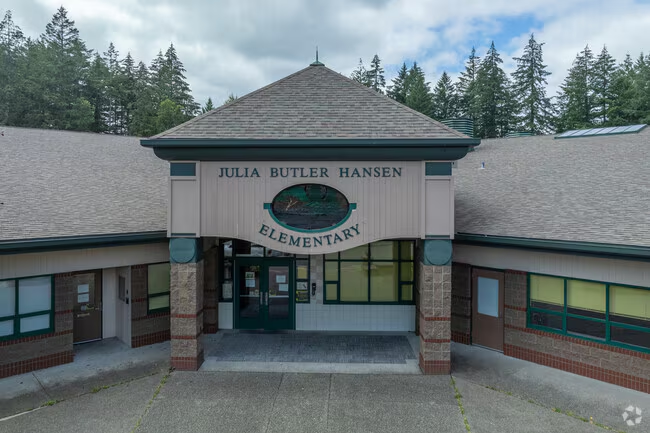
Hansen Elementary School
Starting in the 1980s, the district began using variations on the designs of previous schools to build new ones. McLane Elementary School, Garfield Elementary School, Centennial Elementary School, and Roosevelt Elementary School were all rebuilt on similar plans. All schools had plans used to inform Margaret McKenny Elementary School in 1993, and a variation of McKenny’s building, designed by BJSS Architects, became Hansen Elementary School.
At a time of growth for West Olympia, what was once abundant wetlands and forest around The Evergreen State College became shopping centers, apartments, and housing developments. Lincoln Elementary School, which held both the Options Program and a neighborhood track, had been closed, as the building was deemed uninhabitable in August 1990. The next month, Olympia School District voters approved a record high $49m bond that included the renovation of Lincoln and the building of an elementary school in the southeast and a middle school and elementary school on the westside. When the district did a call out for possible names of a new westside elementary school in late 1993, and the late Julia Butler Hansen, the first female Democratic US Representative from Washington, became its namesake.
Multiple schools, including McKenny, held the Options program while Lincoln was being renovated in the early 90s, but west Olympia’s desire for a mixed-grade model where children learned at their own pace led to the Hansen Alternative Program (HAP), which opened with the school in Fall 1994.
The $5m building was under budget, but toxins from the new carpet had to be aired out and the school did not have drinking water for 2 years after its opening. Copper levels from new pipes left water unsafe, and students and staff drank bottled water instead.
HAP was the only alternative elementary program on the westside until its sudden closure in the 2026/27 school year.
