
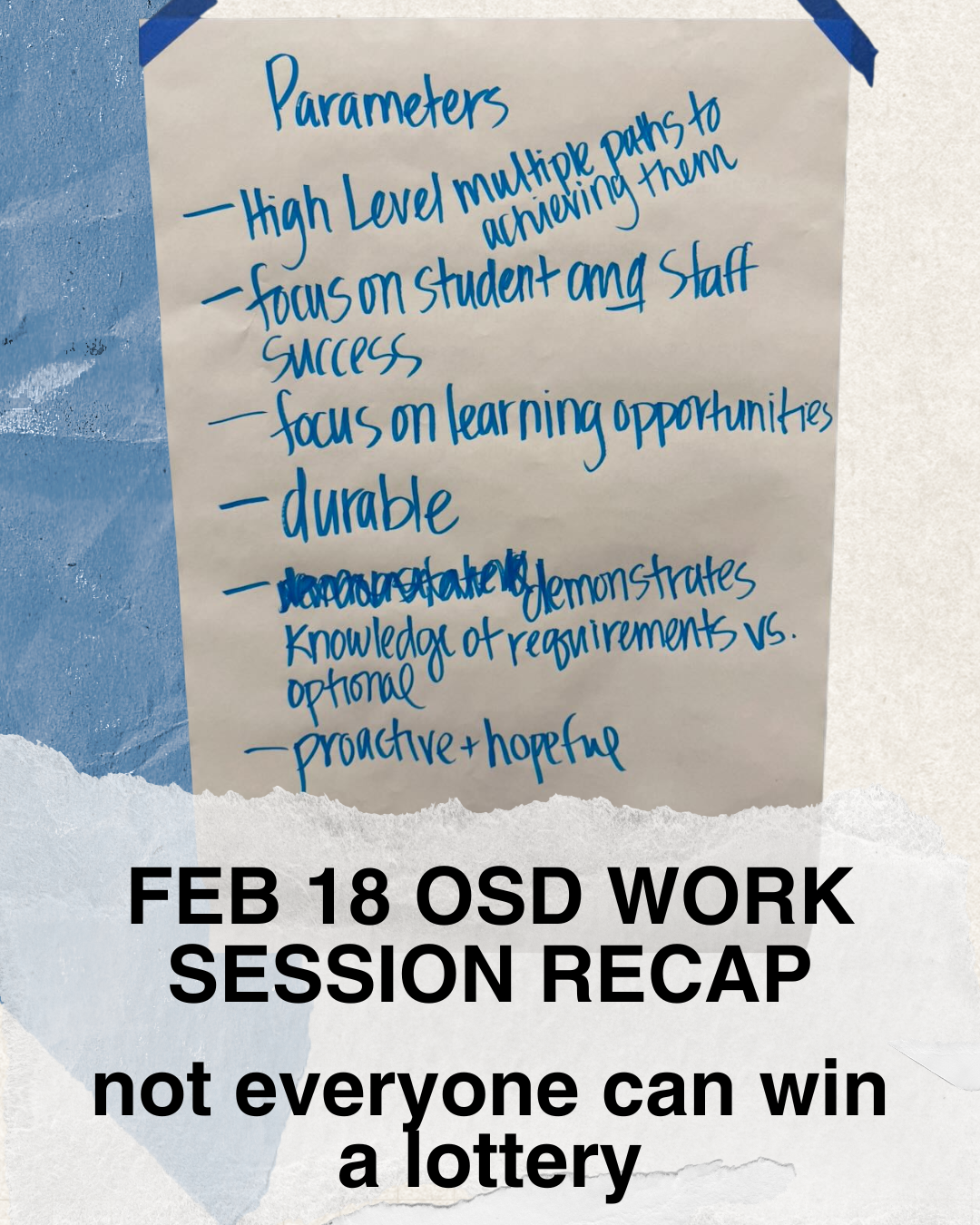

On February 18, the Olympia School District board of directors held the second part of a workshop on budget goals and parameters. Among the topics discussed were the definition of core versus optional services, what defines financial stability, line-item edits, and what is included in our instructional model.
In defining the board’s budget goals, the cyclical year-round nature of the budget process was brought up by Vice President Maria Flores, and the board agreed to starting the cycle goals in January, due to the nature of election appointments. President Jess Tourtellotte-Palumbo said, ‘I think it would be really helpful for the planning phase for the superintendent and others, the staff, but I can absolutely understand, especially somebody who’s going to be retiring in a year and a half.’ While Director Gil Lamont stated, ‘Speaking as a new board member, we’re going to come in on things moving no matter what. So, the sooner we get off parameters, the better. And as a new board member, you’re going to be coming into things already moving. There’s nothing to be done about that.’
Avoiding line-item edits was a goal for some board members, but Vice-President Flores had concern that not allowing budgetary revisions following community hearings would lead to the community feeling unheard and the board approving a budget that may not align with their intentions. Flores noted, ‘I’m struggling with is it is an expectation and we should be able to hear the public and hear from staff. And if there is something, I would hope that we would be aligned and that the administration would also be hearing similar things and that we would receive a budget that feels very aligned with community and staff needs. But there could be an instance where something is missed or something comes up that we did not anticipate. And I’ve just committed to parameters that say I’m not allowed as a board member to enter any line item, edit or to surface an issue that’s brought to me by a constituent.’
Director Seidel cited the Washington State School Directors’ Association (WSSDA) coaching where ‘rather than saying, “I want this staffing line to stay there. I want this program to remain unchanged.” If you have a concern about something not meeting the parameters, that’s absolutely the time to engage in , “Help me understand how you’re going to meet this parameter while cutting the staffing positions.”’
The board then come up with parameters correlating with student success, financial health, and equity, then used stickers to rank those with the most broad consensus. Vice President Flores said of one of her notes, ‘The portion that talks about defining what is core and what is optional. So I think that goes along with durable, but what is our core legal responsibility? What is that we must provide and being able to say these are the optional things that we would consider cutting first because they are optional, not core and required by federal or state law.”
Director Renee Fullerton asked Flores to clarify the definition of an instructional model. Flores explained, ‘So it could be actually explaining all of these different programs that we have fit together in a model that is instructional, that supports instruction, including things that are not academic. So, like, our emphasis on MTSS and using restorative practices would be something that we would include in articulating this is part of our instructional model. We do this because it helps students stay regulated and learn in school. That’s what I mean by it’s all the pieces that we have articulated into a model that says, this is what we provide to our students.”


She continued, “We have a legal responsibility to provide core first and optional is optional. So trying to clarify both to ourselves and to the public, these are our core programs, both for state and federal funding and accountability, things like special ed, you know, things like our multilingual program. All of those are associated in that we agree by receiving state or federal funds that we will provide this to all students…wherever the requirement lies, those have to be provided first. Those are our core responsibilities. Everything that’s discretionary and optional, clarifying these are discretionary and optional programs that we’ve chosen to invest in with our local levy money, or grant programs, or sometimes with our basic ed money, and clarifying that those are optional, those are discretionary, and those would be the things we would consider first, because we cannot eliminate core requirements that are part of federal and state law.”
Director Fullerton saw overlap in her own statement, ‘That’s kind of what I meant by comply with all relative laws…We have to do special education. We have to do multiple learners. These are not optional things. We have to, but I was just framing it through more of a regulatory compliance lens.”
She continued, “I have the same issue with the union relationship, because I saw that as you know, compliant with all of our labor agreements as being part of how we maintain a strong relationship with our union partners. So I wonder if we have some overlap between those.” Flores countered, ‘I want to clarify that mine’s not entirely around risk management. It’s also a part of equity.’
Superintendent Murphy spoke to the Danielson Framework, an evidence-based model, used by the district, but not defined by the district.
‘We just need to put it in sort of a framing and saying, “This is our instructional model.” It will also help us as board members when we’re making decisions to be able to say, “You know, no, we are preserving restorative practices because it helps our teachers be more effective in the classroom, it helps our students learn. It’s putting it in that evidence-based model framework language that Danielson is that will help, I think, us and the community see that these aren’t isolated programs, that they’re selected with intention and that they’re delivered with intention.”
In clarifying, Flores maintained, ‘What I’m concerned with is that we have some offerings that are open only to enrollment through lottery. Not every student can participate, and it’s that tension between are we going to have some programs that only certain students can get into because not everyone can win the lottery? And how does that affect our ability to provide the core for everyone? And yes, [Director Seidel], after someone wins the lottery and is able to enroll in one of those programs, they are receiving core instruction. But my concern is about the equitable access of all students by demographics to those programs is not everyone can win the lottery, and that’s why I was talking about the concept of core and optional, and trying to articulate that there are things that we provide to every student. Every student has a right to attend their school within their attendance boundary. That’s state law. Not every student can get into a lottery.”
While Director Seidel argued that this framing was not a budget parameter, Flores stated, ‘If we are providing staffing and programs that are not offered to all, then we need to be able to justify it. And if it is for an equity purpose, like Avanti, to be able to have a five-year graduation rate and be able to graduate all students. We’re answering that question by doing analysis of the data and looking at the state and federal requirements to achieve that end, but not all of our budget decisions that we are doing provide the same level of access to everyone…There might be other instances where we say this might be a concern because we are using budget for only a small group of students that maybe aren’t identified as being in the opportunity gap, and we might be taking budget away from students who need that and who cannot get equitable access to those services.’
Student Representatives Malachi Cardona and Juniper Hummel-Church both spoke highly of the district’s optional programming. Cardona said, ‘I can see kind of like these conflicting statements in some of them. I felt led as a student representative to put my sticker on the maintain our systems of alternative programs, because I know how valuable those are to our students. I think back to the CSI program in particular at Marshall Middle School that I know provided a lot of students with just a love for the outdoors and some of those fundamental science skills that kind of helps them get ahead in high school, so I just felt like, as someone representing students, it was important to put an emphasis on that, because I know that those systems are really beneficial for students, as they all have different learning styles, and those environments can result in them discovering the essential passions…I did want to speak to any of the elements like the financial health and the financial drivers. That’s where I feel like some of the language is very specific, and I don’t feel like I can speak into that as much, or with as much confidence.’
The final parameter came after student representatives left at 9pm. The 7% Ending Fund Balance seemed too specific for much of the board and OSPI health indicators were decided on instead. A score above 1.75 on a scale of 0-4 indicates financial stability from a variety of factors, and was chosen as a metric. The Olympia School District was at 2.15 last year, and the score was as low as 1.95 in the 2022-23 school year. Superintendent Murphy claimed the district had not dipped below 1.75 in the time OSPI factors had been taken, since 2017-18. OSPI health indicators actually go back further with the 2014-15 school year yielding a score of 2.10.