

On April 23, the Olympia School District (OSD) board of directors passed the Reduction in Force (RIF) Resolution, setting up the district to reach over $1.7m more than the actual deficit and nearly $3m in further cuts, to reach a 7% savings. Vice-President Maria Flores attempted amendments to leave family liaisons (including the 2025 Classified Employee of the Year, Mo El-Sokkary) and elementary art specialists off of the RIF resolution, but it was ultimately passed in favor of possibly leaving positions in the final budget. Also passed were a new Public Comment Policy and the Washington State School Directors’ Association (WSSDA) Legislative Platform Proposal.
The Teacher Appreciation Week Proclamation was postponed due to the nature of the RIF discussion. Most public comment was centered on RIFs. Amber Marusak, a parent with 2 daughters in the Early Childhood Education and Assistance Program (ECEAP) preschool classroom at Garfield Elementary School said, “Summer’s gonna be here before we know it, so all of those parents, children that will be continuing to the ECEAP for one more year, like my daughters. I’m nervous. I’m concerned with there being a bridge, there being communication before you lose families that need this.” ECEAP is set to be contracted to an outside provider in this proposal.
Jefferson Middle School parent Julie Garver was opposed to the $25 device protection fee for Chromebooks. “A $25 fee is not just a short-term solution, it is an evidence of a system making reactive decisions instead of planned ones. These decisions may balance a budget on paper, but they create long-term consequences for families and for the integrity of public education. This cut-by-cut approach does not solve the problem, it spreads it out, normalizes it, and passes it along. Over time, it fundamentally changes expectations.”
Roosevelt parent Chelsee Heley emphasized the work of family liaison Fabiana Eussen and art teacher Cathy Stottlemeyer. Yet the ultimate frustration was class size. “My kindergartner is in a class of 26. My fourth grader is in a class of 30, and the other 4th grade class has 32. I volunteered in these classrooms. The teachers are exceptional, with stellar classroom management skills, but there are only so many fires one person can put out. Smaller class sizes are not a luxury, they are essential for learning.”
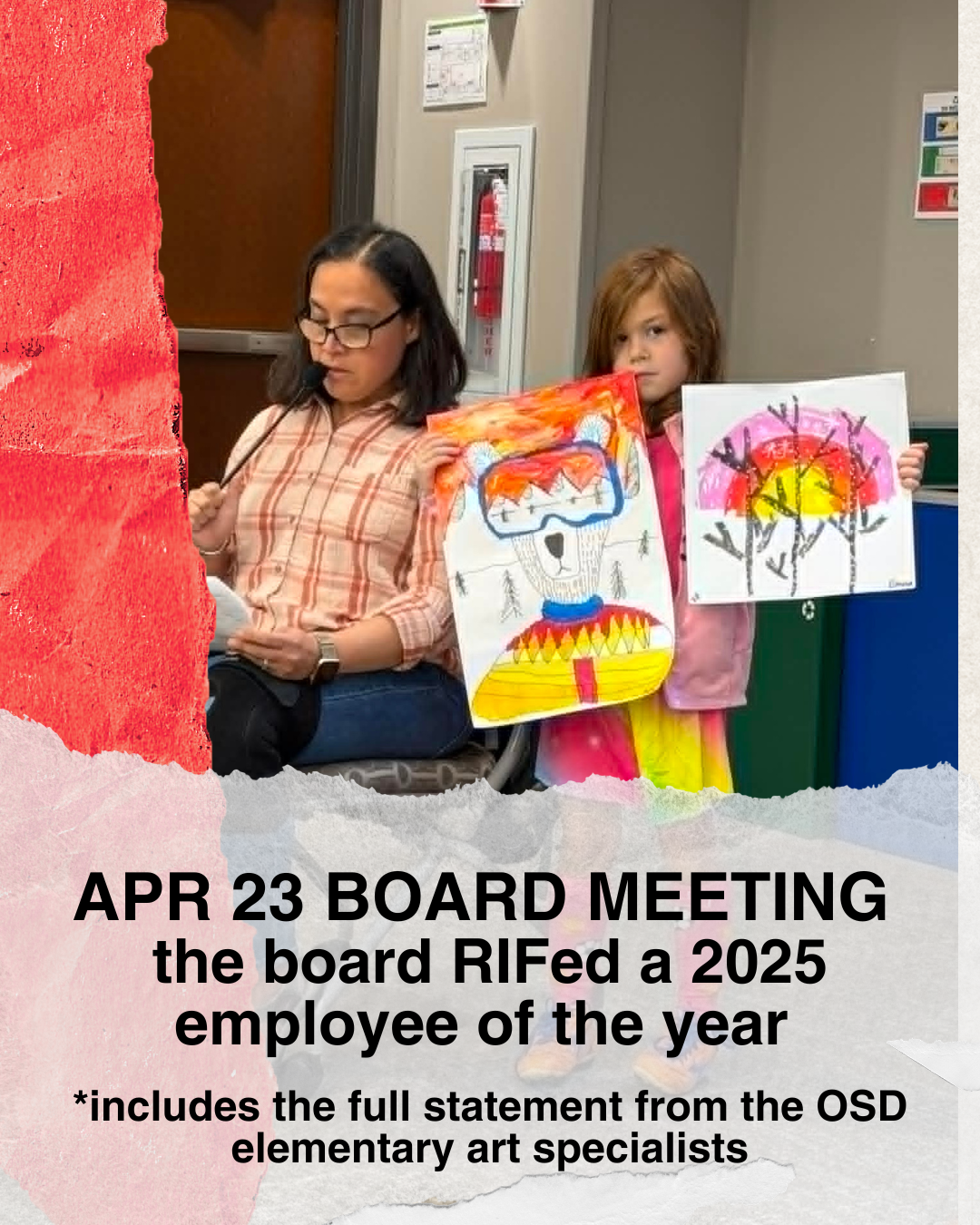
District art teachers Karen Hougan and Katie Jahner, shared comment on behalf of all elementary art specialists.
“Dear Olympia School Board, it has been proposed that the elementary art program be eliminated. The last time this happened in Olympia was in the 1970s, and it took over 40 years to rebuild what was lost.
Let’s be clear, this is not a small adjustment. It is the removal of a core educational experience for 3,689 elementary students, currently served by just 5.4 teaching art positions. For those who question whether art is essential, even in the face of extensive research demonstrating its benefits, this decision raises a more fundamental question. What do we believe school is for?
If education is only about testable content, then perhaps art seems expendable. But if education is about developing capable, thoughtful, resilient human beings, then the arts are not optional. They are foundational. Elementary art education is where students learn to observe closely, think creatively, solve problems, persist through challenges, and discover there are no wrong ways to do art.
Art is a place where kids realize that they possess their own creative identity, separate from their peers. Art is where, to quote Ms. Frizzle, kids are able to take chances, make mistakes, and get messy. These are not abstract ideals. These are the very skills employers, universities, and communities consistently say they value. The data supporting this is extensive, but beyond the data is daily lived experiences in our classroom.
Art teachers serve every child. This includes students with IEPs and 504 plans, multilingual learners, students who have experienced trauma, and those navigating behavioral and emotional challenges. In many cases, art class is where these students first feel successful, seen, and capable. It is where they discover their voice.
Unlike most classroom teachers, art specialists often work with the same students for up to 6 years. These long-term relationships matter. They create continuity, trust, and stability, something that cannot be replicated through occasional, generalized classroom activities. And yet, this program already operates under extraordinary constraints. With just $2.39 per student per year for their budget, art teachers stretch limited resources to serve hundreds of students each week, often 150 to 175 students per day.
They write grants, fund classrooms out of pocket, develop their own curriculum and pursue training independently, all while delivering meaningful instruction in just 35 minutes per week. This is not a program with excess, it is a program sustained by commitment. There is also a legal and ethical dimension.
Washington state law affirms that all students, regardless of socioeconomic status, are entitled to art education as part of a well-rounded curriculum. Eliminating the elementary art program directly contradicts both the spirit and the intent of this mandate.
Finally, there is something harder to quantify, but just as important, joy. Art is one of the few places in the school every day where many students feel free, engaged, and motivated. Joy is not a luxury in education. It’s a driver of engagement, attendance, and long-term success. Eliminating elementary art does send a message not just about budgets, but about values. It tells students, families, and educators, including the art educators, that creativity, expression, and connection are expendable.
These are not trivial losses. They shape who students become. We urge you to send a different message, that the Olympia School District is committed to educating the whole child, and that this commitment will endure. We understand that these are tough financial times. Enrollment is down. Legislative funding did not increase. However, changes may come in the next few years that may free up funds. Do not reactively dismantle an entire program that took decades to rebuild when there could be other solutions. Let’s think creatively to protect it, strengthen it, and ensure that every child in Olympia continues to have access to the transformative power of art.”
Superintendent Murphy initially reviewed the cuts and how they would be replaced by positions throughout the district. Class size expansions in 4-6 grade were shifted from one student per class to 0.6 student per class. “And our school teams work with the principals, and we’ve already found some places where we’re like, that is such a hot spot right now. We don’t know until we see the whites of their eyes on the first day of school, but we have a pretty good indication this is a tough place. Let’s put a teacher there.”
Director Seidel expressed the desire for another meeting after the weekend and to only discuss the RIFs in the Thursday board meeting. Vice-President Flores then requested 2 amendments. One was the strike the family liaisons and art specialists off of the RIF, and the other was to change the total cuts in the resolution to either $2.793m, the “actual deficit amount,” or simply “expenditure reductions to align with anticipated revenue.”
President Jess Tourtellotte-Palumbo also said she would agree to the amendments offered by Vice-President Flores and said she did not believe the loss of the liaisons would be a cut. “The type of support from family liaisons won’t be duplicated if it’s eliminated… and I know we’re not approving the budget, but I wanted to express my inner turmoil with these reductions.” Regarding art specialists, Superintendent Murphy claimed that classroom teachers felt most comfortable replicating art in their classrooms, as opposed to physical education, music, and library time.
Vice-President Flores doubled down regarding family liaisons, “When we take the family liaison part out, we’re missing the rapid response and the person who notices in a very clear way. $340,000 is money well spent that I would like to increase. I’d love us to have a much bigger program when funding increases, so I am very firmly against eliminating the family liaisons.” Flores continued with opportunities to partner with local organizations like the Olympia Education Foundation. The vice-president withdrew her amendments in favor of passing the RIF’s to get notice to unions and staff. Director Seidel said, “We direct the superintendent to bring an updated proposal for family support that maintains some level of dedicated staffing to support families across the district, separate and apart from the social workers.” The RIF Resolution passed unanimously.
For the public comment policy 1400, Vice-President Flores attempted 2 more amendments. One would have all materials up in BoardDocs within 72 hours of the meeting, instead of the legal minimum of 24 hours. Primary reasoning was review time, and online public comment sign up ending before the 24 hour period ends. The second amendment increases the speakers with a 3 minute window from 10 to 20. That passed, with all but Director Seidel voting in favor. There will be in person sign up the day of the meeting and no caps on the amount of speakers, with clear guidelines on time limits.
Lastly, Director Lamont brought forward the WSSDA Legislative Platform Proposal, and it passed unanimously. It would provide further class size flexibility in K-3 and a 3-year enrollment average model that helps mitigate districts in enrollment declines from losing funding too quickly for fixed costs.