

On February 12, the Olympia School Board met in a non characteristic meeting with only a consent agenda followed by an hour and a half work session to go over the budget process. Rohan Sunshu and Sanjay Chandra, students at Olympia High School, came to the meeting to request that financial literacy be a graduation requirement. “Too many students are graduating without a real understanding of how money works,” said Sunshu, “Right now, financial literacy is not required. It’s an elective and not always accessible. That means students can graduate without knowing how to file taxes. Build credit, manage debt. Or even budget responsibly.”
“Nationally, only half of Americans. are considered financially literate. One-third of Americans carry more credit card debt than emergency savings. Nearly 20% say they don’t even have a trusted source of financial education. We wanted to know if this issue existed at our school. So we surveyed over 40 seniors and civics and AP government classes at Olympia High School. 80% say they don’t know how to file taxes, over 75% believe financial literacy should be a required credit. Most students have little to no real-world financial experience.”
In her board member comments, Vice President Maria Flores added that there is a Board of Education Task Force called Future Ready that is looking at recommendations for updating graduation requirements that may include financial literacy as a requirement.
The board reconvened for a work session, led by Directors Renee Fullerton and Hilary Seidel, where they had brought together their individual goals for the district’s budget and used AI in order to find commonalities in their answers. Vice President Flores, not being privy to the structure of the meeting, brought up concerns about transparency. “I think even in engaging this conversation, I’m learning that the intent is to try to do service areas with consensus, which I was unaware of before coming into this meeting, so that could have been highly transparent, but if we are agreeing to get to consensus here, that can only be done with consent. And so, are we assuming that our presence here consent to try to get consensus on budget parameters and process?”
It was unclear if the process would result in consensus or new procedures for the board, but was brought up as a budget guideline review informed by a Washington State School Directors’ Association (WSSDA) workshop that, according to Director Seidel at the January 7 work session, was on “a framework for how to give very specific, but limited budget guidance to the superintendent and their team.”
Much of the board’s conflict was on the specificity of what they were trying to achieve and defining it, as well as how to communicate it. While attempting to define what data would be used to work on the budget, Director Flores wanted to be more specific about the data, while Director Seidel stated, “I think data could be a lot of things. Data could be listening sessions with students, it could be looking at my favorite pastime, the panorama open text responses. Data can be many, many things.” What year the student or district outcomes were created was also up for debate.
When the students were consulted from prompts, they shared that surveys of what they value could be more specific and granular to student experiences and grade levels. Capital High School Representative, Malachi Cardona said, “I also think when you’re asking questions, really understanding who are these questions targeted for? Obviously, they’re targeted towards students, but within that, you have elementary, middle, and high school. I mean, you see this a lot in Panorama survey. They’re the same questions throughout grade levels, right? Each level has a different understanding and a different grasp on what that question means as you get into the higher grade levels, maybe you have a better understanding of what a question is really trying to get at, but when you’re a younger student, you see a broad question. You can kind of take it wherever you want. So, making sure that those questions are also specified for the audiences that exist among the student groups.”
Olympia High School Representative Vy Le highlighted the importance of the impact across the entire student population. ”What kind of students are voting for what kind of programs. For example, sports is probably a really popular one and ASB funding, but it’s a whole lot of overlap between students that prioritized both of those. And so, if you’re kind of smaller program, but that small program supports a demographic of students that don’t have other programs they care about.”
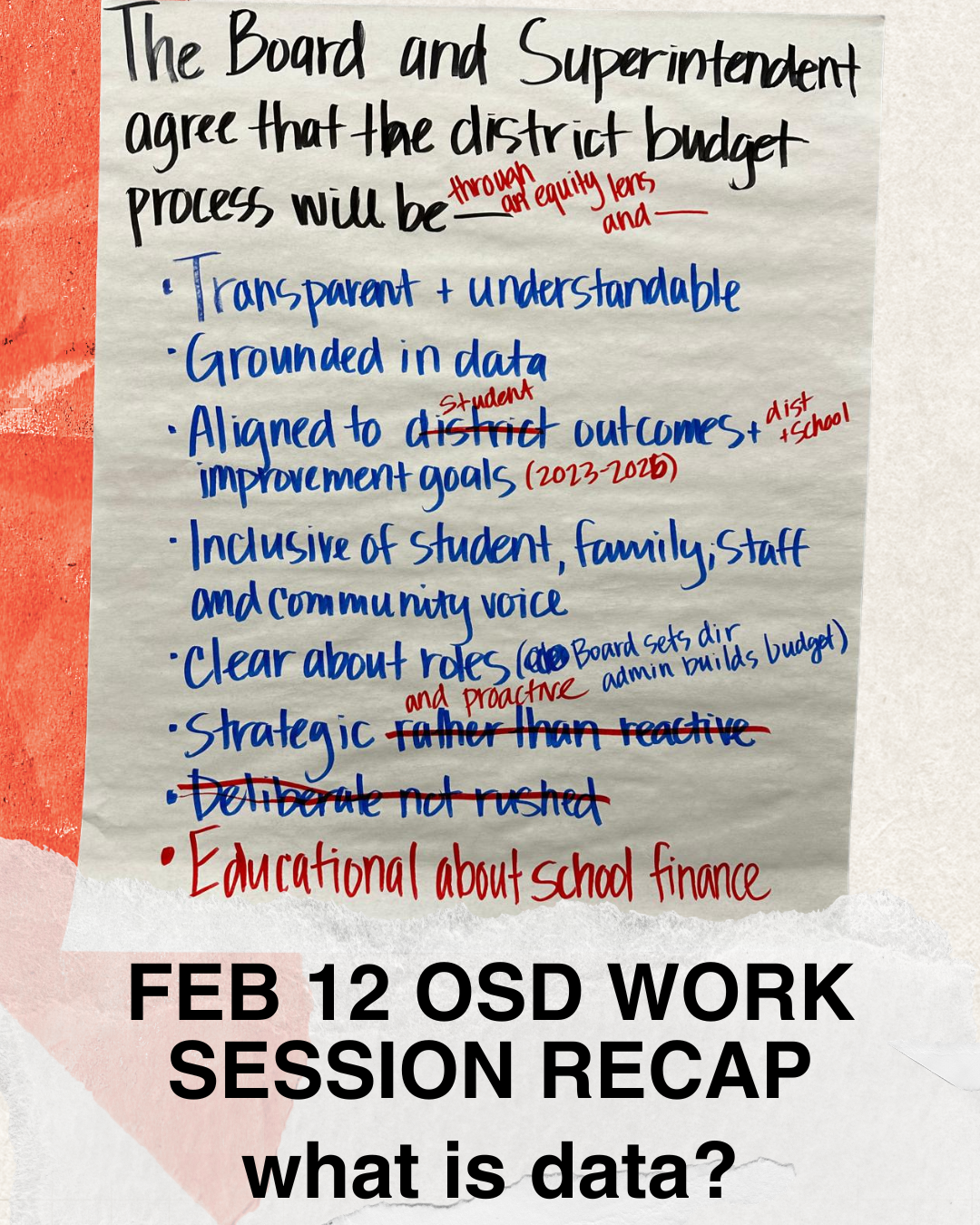
The work session will continue in a second part on Wednesday, February 18, but the final commonalities agreed upon were:
The board and superintendent agree that the district budget will be through an equity lens and
- Transparent and understandable
- Grounded in data
- Aligned to
districtstudent outcomes and district school improvement goals (2023-2026) - Inclusive of student, staff, and community voice
- Clear about roles (board sets dir[ection] admin builds budget)
- Strategic
, rather than reactiveand proactive Deliberate not rushed- Educational about school finance