
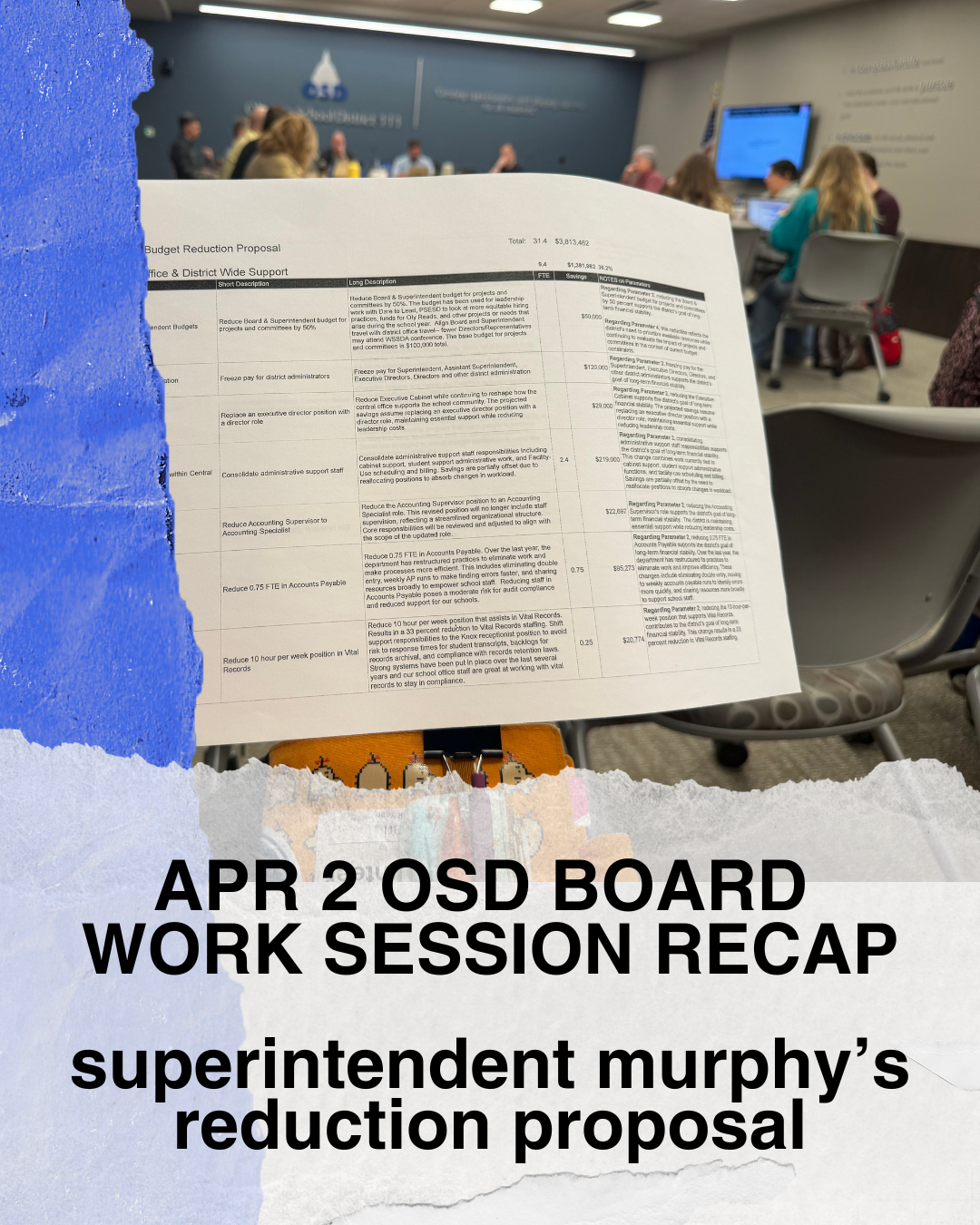

On April 2, the Olympia School District (OSD) board of directors held a work session to answer board questions about the proposed reductions in force by Superintendent Murphy and a peek at WSSDA legislative priorities for next session from Director Lamont. While no mention of how spending will nearly outpace revenue by the end of the 4 year projections, over $2m in further cuts would be necessary to reach a 7.14% savings in 2029-30. Yet Murphy’s talking points were clear. Students are more impacted by formal instruction and instructional coaches than smaller class sizes, family liaisons, and Running Start.
FAMILY LIAISON REDUCTIONS
Superintendent Murphy began by talking about the Olympia model of smaller schools. He referenced the state prototypical model having elementary schools of 450 K-5 students, while it is actually 400 students at K-6. Murphy stated, “There’s growing gaps in the cost for things like substitute teachers… There’s increased costs for operations that we talked about, again, at length around utilities, insurance, and supplies. And we are staffing positions that do not have an accompanying funding source, or they far exceed the funding source. Examples would be positions like… behavior techs, family liaisons, or chemical dependency specialists.”
LP Brown Elementary School principal Sean Shaughnessy said, “We’re in a position right now where we’re having to make choices about how we fund our schools. And in my school, with student learning and student achievement being my number one mission, I am in a position where I’m having to make choices about classroom teachers or a full-time counselor or a family liaison.”
Murphy seems to think COVID impact is over, “We had a year of kids not in school and people were dealing with job loss… and we know that the whole child needs to be served in order to be successful academically, but in terms of the biggest impact in increasing academic achievement, the most important ways you do that is high-quality instruction, standards-based curriculum, formative assessment, and you have principals and instructional coaches and people working together to do that work.” He also referenced the 4 social workers in the district that hold Masters in Social Work (MSW) and the models at Bellevue and Edmonds School District. Edmonds job openings for social work do not require an MSW, and neighboring Tumwater employs family liaisons but not social workers.
Director Fullerton asked about the family liaison’s help with student attendance. Shaughnessy said that family liaisons are on his attendance team. Murphy said absences are less of an issue. “The pandemic helped us in how we support students when they miss school due to illness. So, you know, having Chromebooks. It’s actually more okay to not be in school, which I think is contributing a little bit. And we’ve got graduation statistics, I think we looked at as a board, where we have students that are graduating that are actually chronically absent, and they’re doing okay.”
Vice President Flores pushed back and insisted that family engagement is embedded in the Danielson Framework the district uses. “I’m struggling with the concept that we only needed family liaisons post-pandemic, because many districts have had, like Federal Way, who has had their family academy. North Thurston has their parent resource center. Family engagement has been a long-established practice that some districts do much bigger than we do, and they use their levy money to do it to a much greater extent. And so, I guess I’m just pushing back on that these struggles are going away. They’ve always been here, right? And they’ve just been addressed in different ways, so I just want to lift us back up to the what problem are we trying to solve?”
CUSTODIAN CUTS
Custodian cuts will mean taking portions of several building offline. “We’ve increased our overall footprint, and we’ve reduced custodial staffing by 8.5 FTE since 2018-19, about 1 per year, maybe a little bit more than that. 6.5 of those were subs and 2 of them are swing positions. So again, just trying to do more with less. This proposal would begin reducing the elementary school’s overall square footage by 41,400 square feet out of a total district-wide amount.”
ART SPECIALIST CUTS
Regarding cuts to art specialists, Lincoln Options Elementary School principal Marcela Abadi noted, “At the elementary level, we know that art is an important part of a well-rounded education. It is something that teachers are comfortable integrating into their classroom. While having a stand-alone art class once a week is nice, it often comes with trade-offs. In particular, more transitions, a lack of integration into the curriculum, loss of core instructional time. And in some buildings, such as in Lincoln, there are space challenges. Rose [Lincoln’s art specialist] teaches in the cafeteria.”
One question that stood out was, “Are there administratively burdensome state requirements that the board should consider highlighting for consideration for removal in the future legislative session?”
Murphy pointed to the district’s desire for more classroom size flexibility, “K-3 class size flexibility, which has been our last request, we were unique in the state asking for that. And when I’m in groups with other superintendents, they’re like, ‘I’m curious why you guys are asking that,’ and I don’t know why we’re not asking.”
He also cited Running Start as an issue. “When you’ve got a community college where nearly half of their enrollment is high school kids, they should have the same requirements we do. They should have the same level of accountability. When they don’t do well there or fail out, it’s on us. They don’t transport kids there, they don’t feed them. You know, they’re basically becoming very much like a high school. And they don’t give the counseling support, and our counselors still have to do that, so the 93% to 7% allocation is crazily underfunded… we think that needs to be reconsidered. You know, in our legislative priorities, we said it should be $2,575. And the reality is, as a full-time Running Start student, if they were 25 years old and signed up for the same classes, it would cost about $6,500, and that pass-through is equivalent to about $10,500.”
Community colleges have accountability and requirements as colleges providing college credit, guided by accreditation and state policy for community and technical colleges. OSD also does not provide universal transportation for students in the district engaged in district options. And while OSD gives counseling support and work to ensure students are meeting graduation requirements, colleges also provide tutoring, counseling, and other administrative services. Running Start classes can offer more class flexibility for students, as well as smaller class sizes.
MUSIC CURRICULUM CUTS
Murphy admitted that the proposal that he thought would be least likely to work was regarding music instruction. In Murphy’s propositions, 5th grade instrumental instruction would be mandatory on a semester basis with students taking orchestra for one semester and band for one semester at a reduced 70 minutes a week. Choral instruction and general music would be discontinued in 5th grade. McLane Elementary School principal Dannie Clark commented, “There’s been many times where I have my special education teacher came up and said, ‘Hey, this kid just signed up for band, and that’s when they’re pulled for their minutes, what am I gonna do?’ And then, you know, I’m scurrying to collaborate with the family, and then they’re pulled that morning meeting, and so it just creates, really tricky situations. And when we’re talking about our most vulnerable kids, those are the children that are often, not able to access.”
Murphy stated, “If you look at our scores in the LA and math… we’re higher in 3rd grade, we get lower in 4th grade, and we’re the lowest in math in 5th grade. And I don’t know what the answer is other than the way to increase those scores is more high-quality instructional time. And whenever there’s 90 minutes, up to 90 minutes of instructional time every week with students, that’s a problem.”
That’s when Vice President Flores spoke truth. “Music instruction helps you master math standards.”
Executive Director of Human Resources Scott Niemann said that as many positions would be lost to attrition, as possible. When asked if the district had above, below, or average rates of attrition for this time of year, Niemann said, “Below. And where we need them, we’re really low. Which is, I don’t say that as a bad thing, right? That means that we want people that want to continue working things that are here, so It just hurts in this type of situation.”
Further steps include two Community Listening Forums, at Washington Middle School on Tuesday the 14th at 6pm and Jefferson Middle School on Thursday the 16th at 6pm, reviewing the budget survey, and a preliminary budget at the April 23rd board meeting.
WSSDA LEGISLATIVE PRIORITIES
The board’s legislative representative is Director Lamont and he discussed proposed additions to the WSSDA legislative priorities. When he asked for additions, Vice President Flores said, “Do we want to put out that we are going to have to cut our family liaisons, even though it’s a statutory requirement, and that it should be funded? I know it’s been a lost as platform, but way further down and not a priority, so it’s just a question to you guys. There are districts that would partner with us on that.”
Director Seidel concurred, adding, “I have no problem with throwing the legislature’s staffing enrichment work group report back at them at every opportunity. This is their own report that many people spend a lot of time researching, and they accepted happily, and then they promptly pretended like It was created by aliens.”