
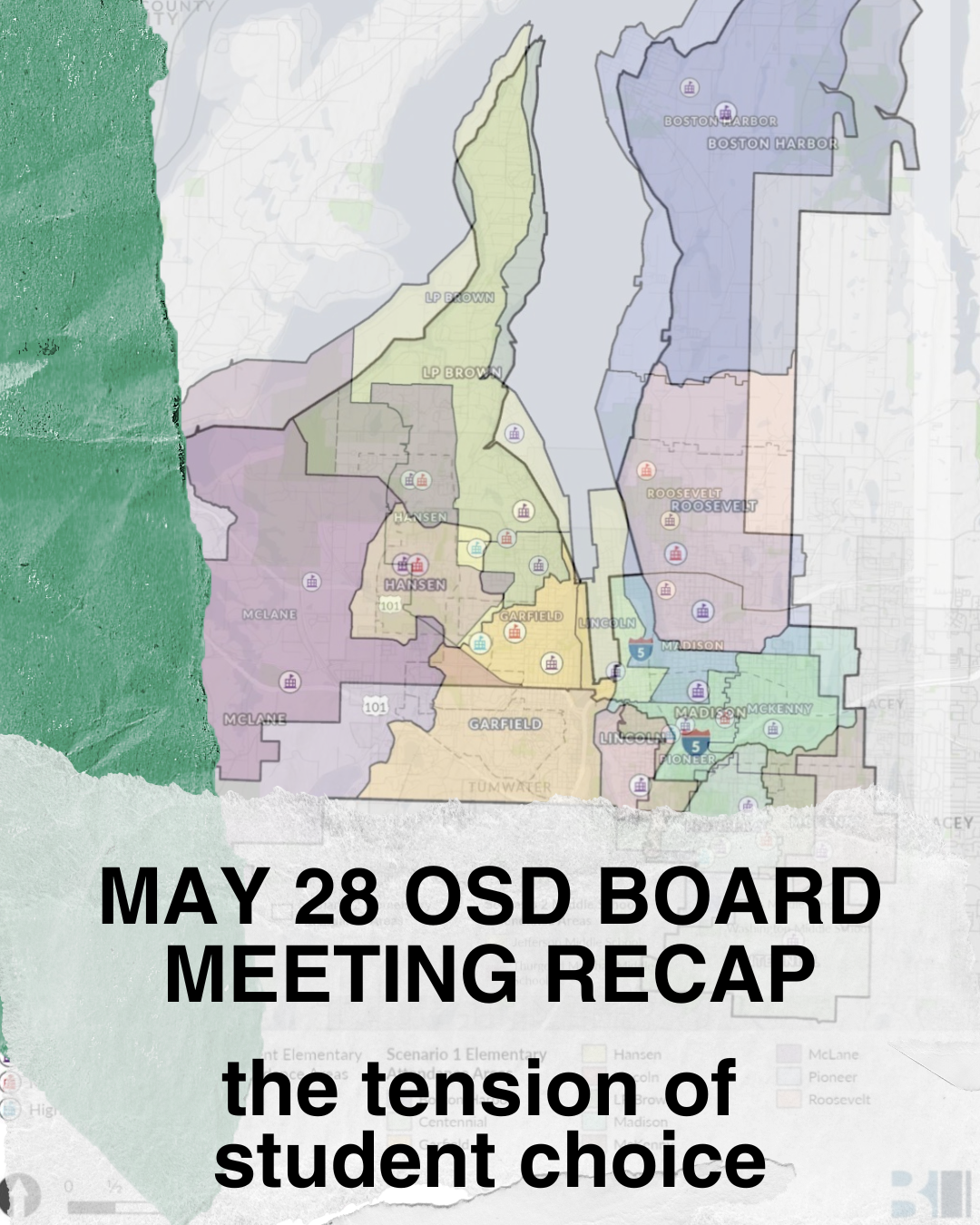

On Thursday, May 28, the Olympia School District held a meeting where they installed the new Olympia High School student representative, Claire Hartzell, and discussed the boundary study, the first of its kind in nearly 3 decades.
Before that though, Director Gil Lamont pulled the Olympia Activities and Athletics Association Collective Bargaining Agreement off the consent agenda, stating, “The financial impact of this agreement is relatively modest in the context of our overall budget, but compensation decisions are among the most important decisions we make as a district. They affect our ability to attract and retain high-quality staff, while also maintaining our responsibility to taxpayers and the long-term financial health of the district. Looking ahead, I’d be interested in discussing whether future collective bargaining agreements should be routinely come before the board on regular agenda rather than the consent agenda.”
The CBA passed unanimously, and Kevin Gifford from BERK went over the boundary study, which appeared to be another attempt to close neighborhood schools. The scenarios balance travel time and middle school attendance. Many assumptions in the presentation by BERK Consulting favored students that choose schools outside their attendance area, which at some schools, as many as 30% of students in an area transfer out of a service area while nearly as many might transfer in.
“Some basic assumptions also that we made for this analysis is we wanted to maintain student choice. So, in all of our testing, if a student record indicated that they were attending a school other than the one for the attendance area where they lived. They were already doing an in-district transfer. We respected that choice, and when we redrew the boundaries, we did not reassign them to the new school. We assumed that everybody who’s currently attending, doing one of those transfers, that would be, respected and maintained.”
Gifford further explained that these factors “kind of blunt the effect of any boundary revisions, because you don’t really know how many of the students that you’re going to encompass in that attendance area will actually be attending the school that they’re assigned to.”
Director Fullerton acknowledged this tension, stating, “While I know how many of our students are traveling for student choice, as you recommended, but also, I think, correct me if I’m wrong, for the district’s choice around where there’s a DLC classroom [developmental learning classrooms] with space, where we’ve placed the GROW program [a behavioral program at Roosevelt Elementary], where we’ve placed ALPS [a highly capable classroom at Roosevelt Elementary], and sort of all the other programming that exists in there. And so, I’m having a hard time reconciling the numbers done on geography versus how the numbers break out based on district programming choices.” Fullerton also inquired whether students that qualified for special education at some classrooms were being served closest to their home.
Regarding demographics, Vice-President Flores mentioned that we needed to not create further segregation. “A lot of what we see about demographic patterns concerning race is just about historical redlining within Olympia, which is just the history that we live with in this community, and we just need to say it out loud.”
Monday June 8, there will be a work session on the budget and the boundary review, followed by a June 18 first budget reading and June 25 public hearing and second reading.