
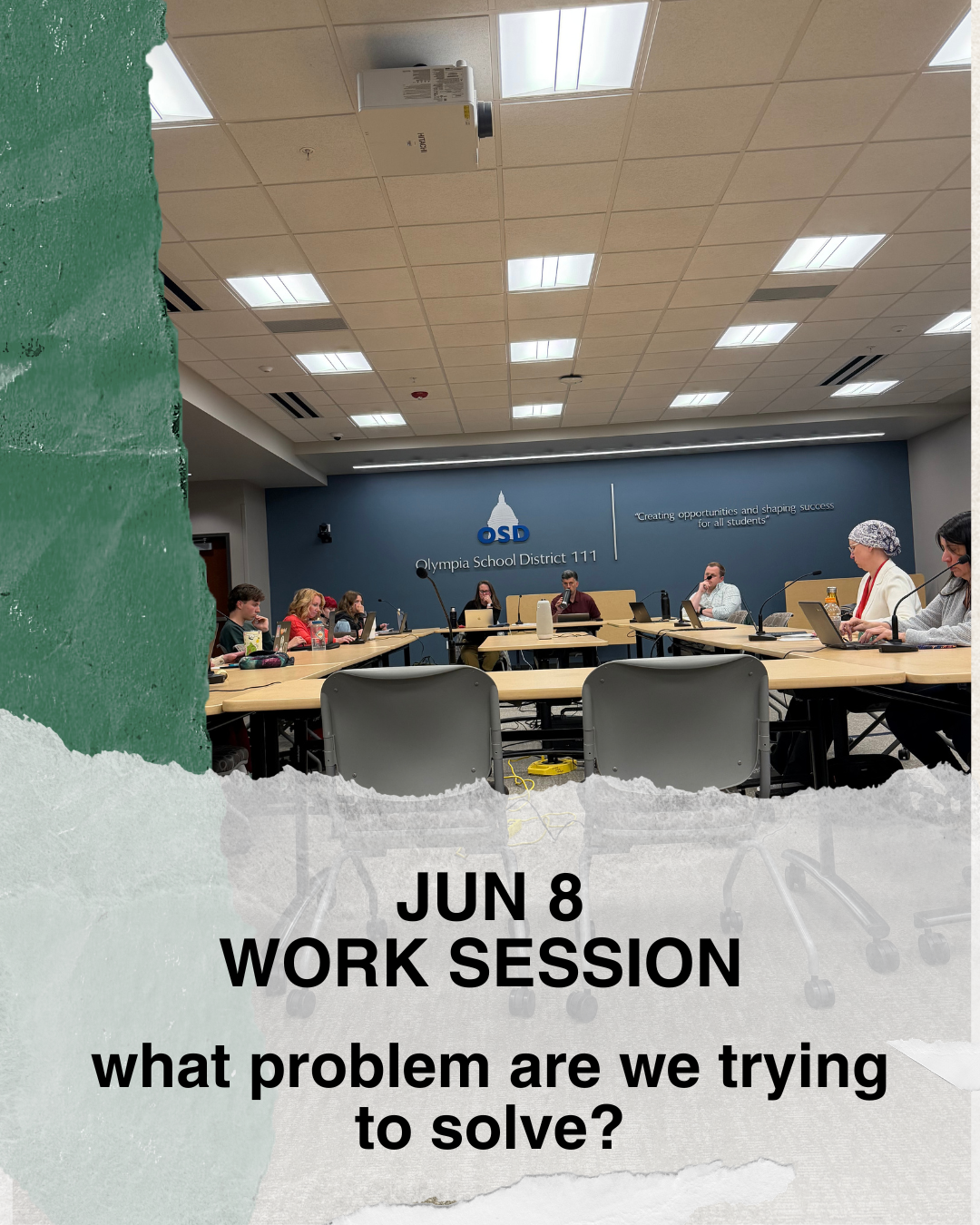

At the June 8 Olympia School District (OSD) board of directors work session, Superintendent Patrick Murphy laid out his intentions for family engagement, integrating art into elementary classrooms, and he interpreted the purpose of boundary reviews. Long term financial stability with an intention of school closure is likely to be front and center at the August 29 board retreat.
The board first went over a document showing the effects of a very laid back OSD transfer policy. Some examples included that the Jefferson Middle School service area only had 305 students, while the school itself had 453 students this September. Schools without catchments, like ORLA and Avanti, bring in the most out-of-district students, and those students have reached over 10% for the first time in the district’s recent history. Vice President Maria Flores asked how families in other districts find out about the hConnect program and Murphy was unaware and deferred to the Executive Director of Teaching & Learning Inger Owen.
Owen said, “Online programs are limited unless you have a certification as a multi-district provider, you can’t serve more than 10% of your students if they live or reside outside your district. ORLA’s one of, there’s several in the state, but, in this region, ORLA’s one of the only multi-district… online providers.” She claimed that families often found ORLA programming via that status. ORLA is cutting grades K-5 in ORLA Online next year.
Executive Director of Student Support Ken Turcotte spoke to Developmental Learning Classroom (DLC) placement saying of the approximately 100 elementary school DLC students, only 45% are served by their neighborhood school. Though he only mentioned Boston Harbor, Madison, and McKenny not having DLCs, Roosevelt does not have one either, leaving the northeast and peninsula unserved.
The superintendent then laid out intentions for two new district level positions. One would train teachers and administrators in family engagement and home visits, and one would be an Art Teacher on Special Assignment (TOSA) to help elementary school teachers integrate art curriculum. The board had multiple concerns over the capacity of these positions to replace art specialists and family liaisons. Flores believed the district needed to adopt a family engagement model, citing OSPI’s dual capacity framework. Director Renee Fullerton was focused on what qualifications these positions would have. And President Jess Tourtellotte-Palumbo questioned their allocations and if they were permanent. Murphy said of the jobs, ‘I think the bulk of this work should be about teaching people to fish, as opposed to giving them a fish.’ The general concern was if there would be enough to replace the positions cut in the Reduction in Force (RIF) proposal.
Flores said, “At that meeting [the April 23 board meeting], I said people. I said plural, I don’t think I said, “person at the district office,” and I know that that’s not what’s coming forward, and so I’m not sure what to do with that, because I’m still…concerned about how we effectively catch the kids who fall through the cracks.” Several more questions were left unanswered, including the bigger picture for family engagement and how home visits will work.
The superintendent was tasked with devising a new model for family liaisons and art to bring forward to the board in the first budget reading on June 18.
Of the boundary study, Murphy said, ‘We didn’t ask them to do this boundary study because there was a push from the school board, myself, or anybody that says, these boundaries need to be changed on these schools right now, and we need to move these kids here and these kids there. It was more an ask of are we a good candidate for this? Do we have a present situation that we would benefit from moving the boundaries around at our elementary or middle schools, particularly?’
Murphy failed to mention that it had been a over 3 decades since parts of the district were assessed, and Westside boundaries result in portions of increased transport and redlining. The purpose of boundary reviews isn’t to create more students, but to effectively deliver programming closest to where students live, without racial or socioeconomic segregation.
While Vice President Flores asked how utilization calculations were made, and how they affected class sizes, Director Hilary Seidel said “We have a way that we go about calculating class sizes that is based on what the reality is also in our district, so it’s not like 25 is an arbitrary number we just grabbed out of the sky. It’s rooted in our own actual bargain…You could say, “Okay, we’re going to use 21,” but if the question is fundamentally about how do we set aside resources so that we can keep our district functioning sustainably, then lowering class sizes by 4 or 5 kids doesn’t get us there.’ Director Fullerton noted, ‘What is the problem that this particular piece of work was intended to try to solve? Which, to the points you raise, are not problems we have. Insofar as we are not a rapidly growing school district, we do have some oddities, depending on the borders on the west side of town, but we don’t necessarily have some schools hugely move over capacity, while other schools are not in capacity… I don’t think there is any one solution, necessarily, but a challenge that is ahead for us as a school district, and yet I feel like I’m being given pieces of information piecemeal. Like, here’s this piece of information about this, which is this aspect, but is not arranged with all the other different problems that are in front of us.’
Issues with schools that contain fewer common spaces was not addressed, but Murphy admitted that utilization was not about student achievement. ‘I was very adamant that it was not about the academic performance or anything like that related to schools. It was about the number of students we have, the number of buildings we have, the capacity that we have at those buildings, and the duplication of staff, and the possible savings of not running our district that way.’ The board will meet with the Olympia city council on July 30 to discuss the boundary review more.
And Murphy noted, “There will be a first reading [of the 2026-27 budget] on June 18th, and a second reading on June 25th. We talked about some proposed positions in here, I took notes about things we might change on some of that. When we get this budget squared away for 26-27, my intention is to come in this summer at the retreat, and bring you a proposal of everything all together about a longer-term solution to our fiscal problems.”
The final agenda item regarded the Washington State School Directors’ Association (WSSDA) Conference in November. While Director Seidel insisted on the value to the board and student representatives, Director Lamont disagreed on the necessity. ‘To me, it’s an optics issue. I mean, when you really get down to it, we’re not allowing staff to receive training, but we are extending that courtesy to ourselves. We’re not holding ourselves to the same standard that we’re holding our staff to.”