
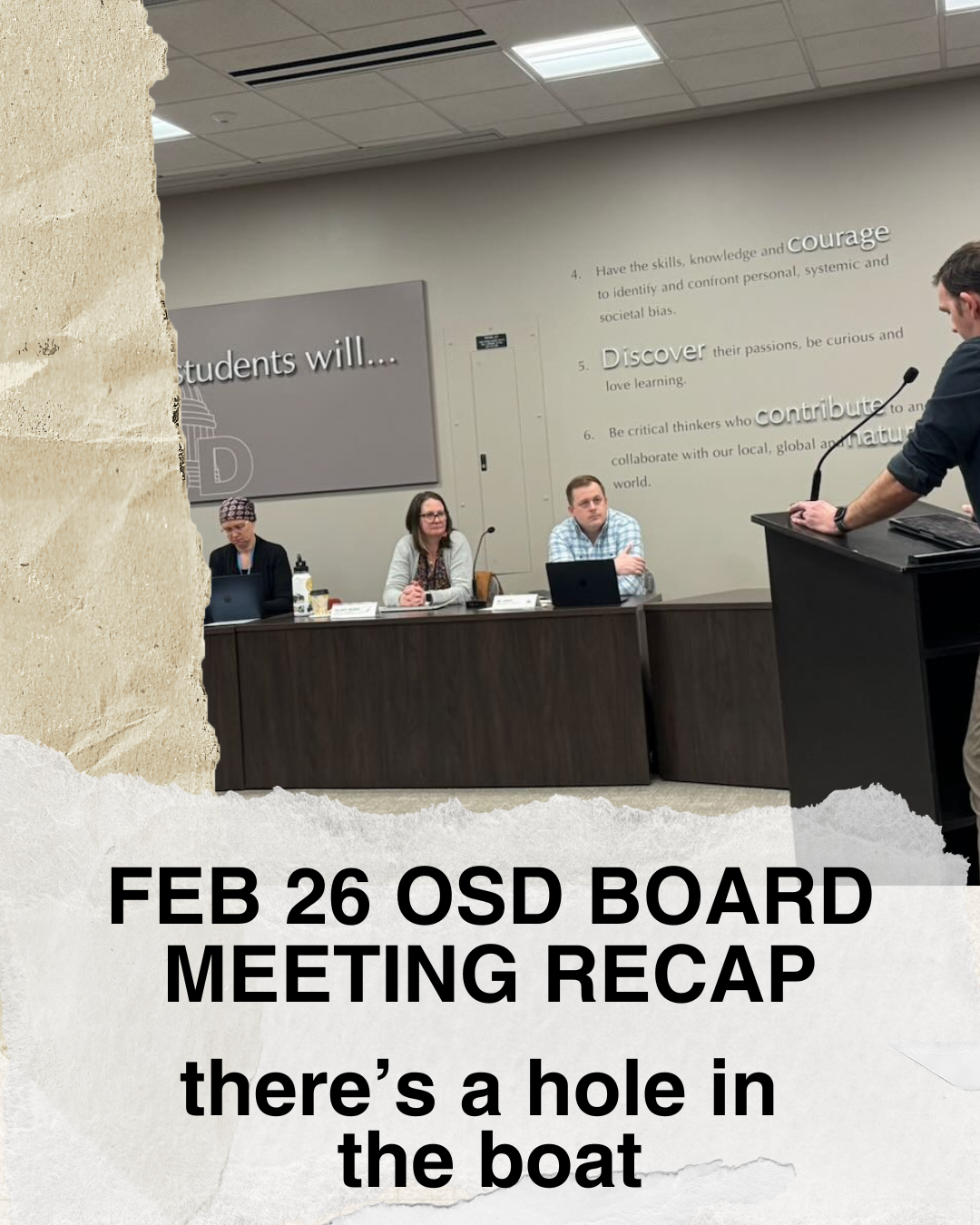

On February 26, the Olympia School District (OSD) Board held a meeting concentrating on the board’s budget process and the superintendent’s budget outlook. In the June 12, 2025 school board meeting, Superintendent Murphy outlined his goals of staff reductions, closures, and larger class sizes in an attempt to have a larger ending fund balance (EFB). In this meeting, Murphy, with one school year left in his contract, doubled down on this goal.
Teamsters 252 representing OSD’s custodial, transportation, and maintenance workers were present with head Capital High School custodian Nguyen Phan giving public comment on the district not rehiring custodians. “We respectfully ask the superintendent and the school board to review the current staffing condition to ensure our school remains safe, clean, and well supported for all students.” The Olympia Paraeducators Association (OPA) also had a 3 year contract renewal approved in the consent agenda.
While the board spent 2 work sessions going over budget parameters, and settled on the Office of the Superintendent of Public Instruction’s (OSPI) financial health indicator being over 1.75 (the lowest score without state oversight consideration) on a scale of 4, the superintendent made a long and loud case for why the district needed to have both a 7% ending fund balance and a higher health score.
Murphy summed up his presentation with, “Given the enrollment decline, given the categorical funding decline, given the slight increase in classroom ratio, and monitoring the number of retirements and resignations that we have on file with the Human Resources Office right now. I’m not comfortable that we can place teachers next year with those reductions. Not saying that it’s absolutely going to be necessary, but I intend to bring a resolution to the board at your first meeting in March to authorize, if you approve it, for us to start planning for a reduction in force.”
Executive Director of Finance Kate Davis said, “It’s real dollars, and that we have to consider. So the analogy being that there’s a hole in the boat like we’re spending more than is coming in, and that would be something that we would want to plug up. Days cash on hand is directly related to having a larger fund balance. We’re not going to have as much cash on hand if we didn’t even start the year with a higher fund balance.” While the district has never dropped below 1.75 on the OSPI indicator and their EFB has always been higher than budgeted, the district is spending more than it makes by $1.9m per year.
When discussing borrowing from the debt service fund to implement upgrades to the Freedom Farm, Davis said at the September 25, 2025 board meeting, “The folks that calculate those ratings would love for us to just have a very, very large fund balance and not be spending money. But…we’re a public agency. We’re not supposed to just sit on large fund balances and not do services for our communities. So, we shouldn’t let that rating be dictating the policy choices that we make.” So, should it? Even as the state has lifted the cap on the levy and on special education, adding $24.7m to this year’s revenue, even with cuts, OSD looks primed to overspend by the end of the decade, and an increase of the EFB will not solve that problem.
If the 7% goal is an exercise in trying to achieve long-term budget sustainability, then revenues would continue exceeding expenditures by 2029-30 in the graph below.

Fig. 2: Comparison between “assuming spending at the same rate and no cuts taken” (LEFT), and “assuming cuts are taken to reach 7% fund balance in 2028-29” (RIGHT).